
A lot of us experience relationship anxiety. Relationship anxiety can show up as constant doubt, overthinking, or a lingering fear that the person you love will eventually leave. It can be confusing and exhausting.
Dealing with relationship anxiety isn’t easy, but it is possible. Learning how to deal with relationship anxiety doesn’t mean never feeling anxious again. It’s about understanding where it comes from, calming your nervous system, and building emotional safety within yourself and your relationship.
What Relationship Anxiety Feels Like
Relationship anxiety is more than just worry. It’s a persistent sense of unease rooted in the fear of abandonment. It’s the deep discomfort and sense of uneasiness that comes from not being able to completely trust the person.
Even when your partner reassures you, saying they love you, want to be with you, and aren’t going anywhere, something inside you still doubts it. You might find yourself waiting for the other shoe to drop, scanning for signs of rejection, or replaying interactions over and over.
You might notice thoughts like:
- They didn’t text back right away. Are they pulling away?
- He normally texts me every morning. How come he did not text me today. Did I say something I shouldn’t have ?
This constant state of hypervigilance can make you feel exhausted, emotionally drained, and disconnected from yourself.
If both partners carry their own insecurities, the anxiety can intensify, each person’s fear triggers the other’s.
(If you haven’t already, read Signs of Relationship Anxiety for a deeper understanding of what this looks like in daily life.)
Why Relationship Anxiety Happens
Everyone enters a relationship with their own parts that have been shaped by past experiences. The parts that fear rejection, crave reassurance, or struggle to trust love. Relationship anxiety often develops when old emotional wounds are activated in present-day connections.
These wounds may come from:
- Childhood emotional neglect or inconsistency
- Growing up with unpredictable or emotionally unavailable caregivers
- Past relationships involving betrayal, abandonment, or emotional manipulation
- Low self-esteem or deeply held beliefs of being “not enough”
When these parts get triggered, your nervous system shifts into protection mode. You may cling, withdraw, overanalyze, or shut down, not because you don’t love your partner, but because your body is trying to prevent future pain.
Understanding how to deal with relationship anxiety starts with recognizing that anxiety is not coming up to disrupt your life, it’s a protective response shaped by your history.
How to deal with relationship anxiety
1. Get Curious About Your Triggers
Start by noticing when your anxiety spikes. Is it when your partner takes longer to respond? When they need alone time? When plans change unexpectedly?
Notice how the anxiety that just got triggered shows up in your body. Notice your thoughts. What are you telling yourself?
Ask yourself if this feeling feels familiar and if you have felt like this before?
Ask the part that’s anxious, what does she need right now? Check in to see how can you be there for yourself in that moment.
2. Regulate Your Nervous System
Relationship anxiety lives in the body as much as the mind. When your nervous system is activated, logic alone won’t calm it. Your body stores the fear of rejection, and your nervous system reacts before you can understand what’s going on. Sometimes you might feel like, “I don’t know why am I so upset about this, when I know he/she will not do anything to hurt me.” Logic will not help you regulate.
When you notice yourself spiraling, try to ground yourself:
- Move your attention from what happened- Bring your attention to your body. Notice if you feel any stress or tension in your body. If you do then put your attention there.
- Pause and breathe slowly – Inhale through the nose, hold the breath for a few seconds and exhale longer through the mouth. Do this a few times.
- Connect with your senses- Notice your feet on the ground, notice the colors around you. notice five things you see, four you can touch, three you can hear. Put Ice pack at the back of your neck, splash your face with cold water
- Place a hand over your chest – Say to yourself, “I’m safe right now.” ‘Right here right now at this moment I am safe.”
- Move your body gently — go for a walk, stretch, or step outside for fresh air.
Self-regulation is your responsibility; your partner’s presence can help, but you are the only one who will be able to calm their nervous system. It doesn’t matter what your partner does or says it will help a little but not completely subside your anxiety. An important skill in learning how to deal with relationship anxiety means taking responsibility for soothing your own nervous system.
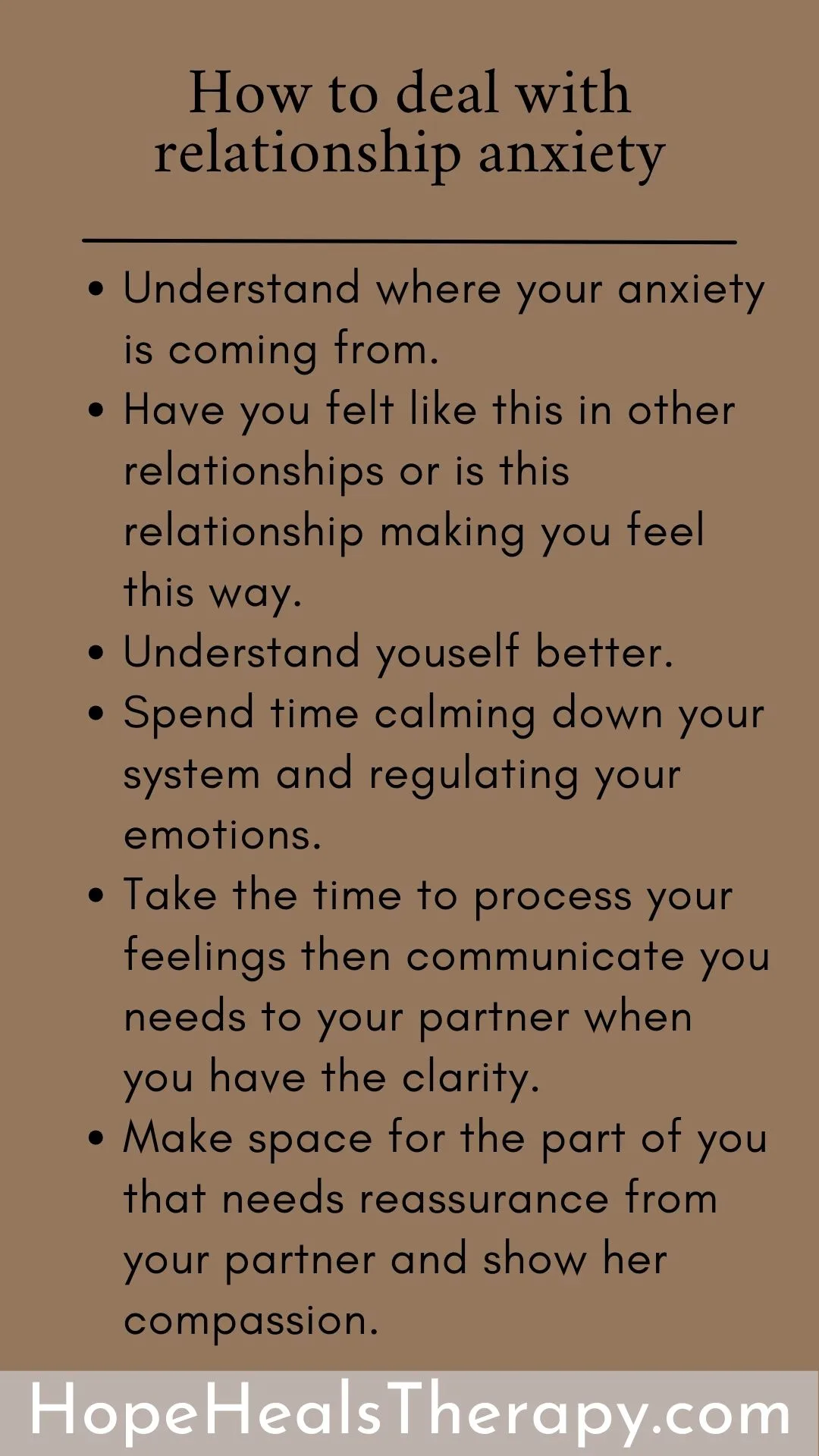
3. Take Responsibility for Your Inner World
We all have wounded parts that long to feel chosen, loved, and secure. But those parts are our own to care for.
Your partner can be supportive of you as you make space for your younger parts and help them heal, but they cannot fill every emotional gap left by your past. Expecting them to do so creates pressure and can actually heighten anxiety. Your partner is in a relationship with your adult part, he will not know how to attend to your younger parts.
In an adult relationship which is a partnership you are responsible for your nervous system and your partner is responsible for theirs.
Healing means learning to soothe the parts of you that feel unworthy or scared, offering them the love, patience, and validation they missed before.
Read Signs of Codependent Relationships to clarify the difference between healthy reassurance and emotional reliance.
4. Communicate Without Blame
Relationship anxiety can make communication feel risky. It often makes communication defensive or demanding, either demanding reassurance or withdrawing to avoid rejection.
Instead, try to share your feelings with ownership and clarity.
- Instead of: “You never text me back; you don’t care.”
- Try: “When I don’t hear from you, I start to worry. A quick message helps me feel connected.”
- Instead of: “You’re always so distant lately.”
- Try: “When you seem quiet or withdrawn, I start to feel anxious and disconnected. It would help if we could check in about what’s going on.”
Open communication builds safety on both sides. It helps your partner understand how to support you without feeling blamed or overwhelmed.
5. Strengthen Your Sense of Self
Anxiety increases when your identity becomes overly tied to your partner. You will not feel as anxious in your relationship if you have a world outside of your relationship. Build routines and activities that remind you who you are.
That might include:
- Spending time with friends or family.
- Engaging in hobbies that bring joy or creativity.
- Journaling or meditating to reconnect with yourself, spending time out in nature.
- Setting small goals that reflect your independence.
The more grounded you feel in your identity, the less anxious you’ll feel when your partner takes space.
6. Reframe the Way You See Space and Distance
For anxious partners, space can feel like rejection. But in healthy relationships, space is necessary — it helps both people recharge and bring their best selves to the connection.
Try to remind yourself: “Space doesn’t mean disconnection; it means security in the relationship.”
You and your partner can love each other deeply and still need time apart. Allowing room for individuality helps both partners show up more grounded and present.
7. Seek Professional Support
Relationship anxiety is layered and deeply rooted in past experiences.
Trauma-informed approaches like EMDR (Eye Movement Desensitization and Reprocessing) and IFS (Internal Family Systems) help:
- Release stored fear in the body
- Heal attachment wounds
- Build internal safety and self-trust
You don’t have to figure out how to deal with relationship anxiety alone.
Learn more about- IFS, EMDR and Individual Therapy for Relationship Issues
When a Secure Partner Helps You Heal
If one person in a relationship is secure and grounded, their calm presence can help regulate the other’s nervous system. Over time, trust grows, guards soften, and anxiety lessens.
But this only works when both partners take responsibility for their inner worlds. The secure partner can offer reassurance and consistency, but you still have to meet your own fears with compassion.

Healing relationship anxiety is a shared process — one rooted in self-awareness, accountability, and emotional safety.
Gentle Reminders as You Heal
- You can feel anxious and still be worthy of love.
- Your fear of abandonment is a wound that needs attention and healing.
- Relationships don’t heal you, they reflect what needs healing.
- Safety begins within your own nervous system.
- The reassurance that you are seeking from outside, your nervous system needs that from you.
Learning how to deal with relationship anxiety is a gradual process. Progress comes from compassion, not pressure.
FAQ: How to Deal With Relationship Anxiety
Can relationship anxiety ever fully go away?
It can significantly decrease with self-awareness, emotional healing, and nervous system regulation. The goal is to learn to calm yourself and build secure patterns.
Should I tell my partner about my anxiety?
Yes, in a grounded way. Communicate your needs and triggers without blaming them. This fosters understanding rather than defensiveness.
How can I support a partner with relationship anxiety?
Offer consistency, patience, and clear communication. Reassure through actions, not just words — but also maintain your own boundaries and self-care.
What’s the difference between anxiety from trauma and actual relationship problems?
If your partner is kind, consistent, and communicative, but you still feel anxious, the root is likely internal. If they’re dismissive, disrespectful, or unsafe, the anxiety may be a sign to re-evaluate the relationship.
Can therapy help both partners?
Absolutely. Individual therapy helps each person understand their patterns, while couples therapy supports healthier communication and emotional regulation.

Anusree Gupta
Author
Anusree Gupta is an EMDR-certified and IFS-trained trauma therapist specializing in anxiety, people-pleasing, childhood and relationship trauma. She provides online therapy across Texas, Washington, and Florida through Hope Heals therapy. As an EMDRIA approved consultant she also provides EMDR consultation to therapists (US & Internationally).
Recent Comments